
They are literal dinosaurs
Birds are the one theropod lineage that survived the asteroid. When researchers recovered collagen fragments from a 68-million-year-old Tyrannosaurus rex femur, the closest living match on the protein tree was the chicken.
Est. 2024 · An independent field guide
Three chickens for every human alive. Faces remembered for months, dreams, deception, a mental number line. And two arcade games that turned the oldest joke in comedy into a genuine test of nerve.
01 — The strange truth
Everything below comes from published ethology, archaeology or genetics. None of it is folklore, and almost all of it surprises people who grew up thinking chickens were simple.
Birds are the one theropod lineage that survived the asteroid. When researchers recovered collagen fragments from a 68-million-year-old Tyrannosaurus rex femur, the closest living match on the protein tree was the chicken.
Newly hatched chicks tested with hidden objects behave as if they can add and subtract small quantities, and they place smaller numbers to the left and larger to the right — the same mental number line humans use.
Shell colour is genetic, not dietary. Araucanas lay blue, Marans lay chocolate brown, Leghorns lay chalk white, and Olive Eggers lay green because a blue base is painted over with brown pigment on the way out.
Chickens use around thirty distinct vocalisations. Crucially, the alarm call for a hawk overhead differs from the alarm call for a fox on the ground, and flock-mates respond correctly to a recording even with no predator present.
In the final days of incubation a hen clucks softly to the eggs and the chicks peep back. They hatch already knowing her voice, and clutches synchronise their hatching by clicking to each other.
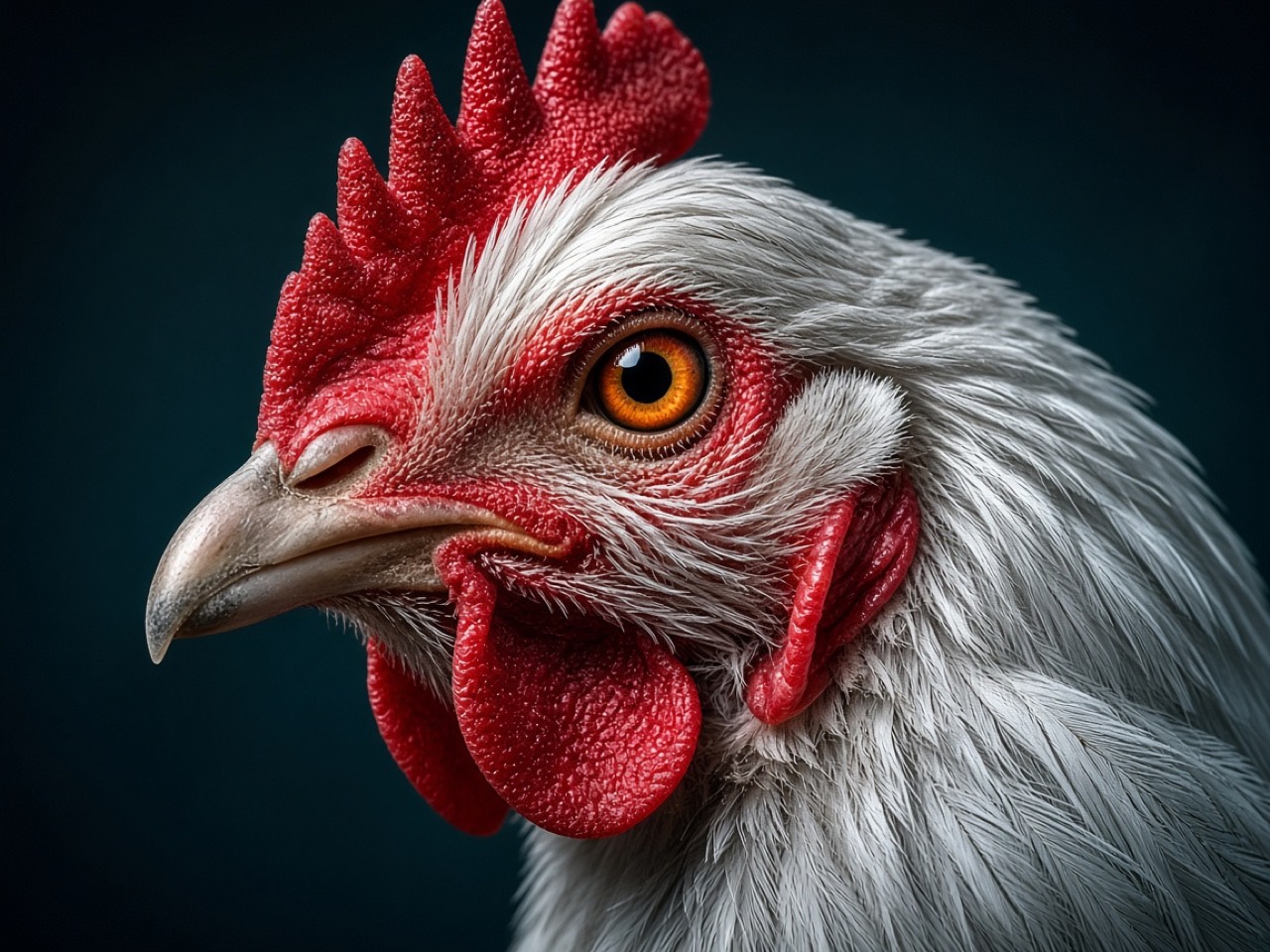
A chicken's right eye handles close focus and food discrimination; the left eye watches distance and scans for threats. That is why a hen studying you sideways is not being odd — she is choosing a specialist.
Chickens are tetrachromats with an extra cone for ultraviolet plus oil droplets that sharpen hue separation. A chicken looking at a plain green lawn is seeing a richer image than you are.
Norwegian zoologist Thorleif Schjelderup-Ebbe described it in the 1920s. It is a stable, memorised, largely non-violent hierarchy — the fighting happens once, and after that everyone simply remembers.
Offered a small serving of food now or a larger one after a delay, hens routinely hold out for the bigger reward. Self-control on a timer was not supposed to be on the menu for a bird.
A rooster performs a food call to summon hens. Some roosters make the call with nothing on the ground at all — deception that works until the hens learn which rooster is a liar and stop coming.
Current archaeology places domestication from the red junglefowl of Southeast Asia around 1500 BCE, drawn out of the forest by newly farmed rice and millet fields rather than captured by people.
EEG studies show chickens enter REM sleep. They also sleep with one hemisphere at a time, leaving the matching eye open — the birds on the outside edge of a roost keep their outward eye watching all night.
02 — The game
One button. One lane at a time. The oldest joke in comedy turned into the cleanest arcade loop of the last decade.
Arcade · Free to play · No wagering
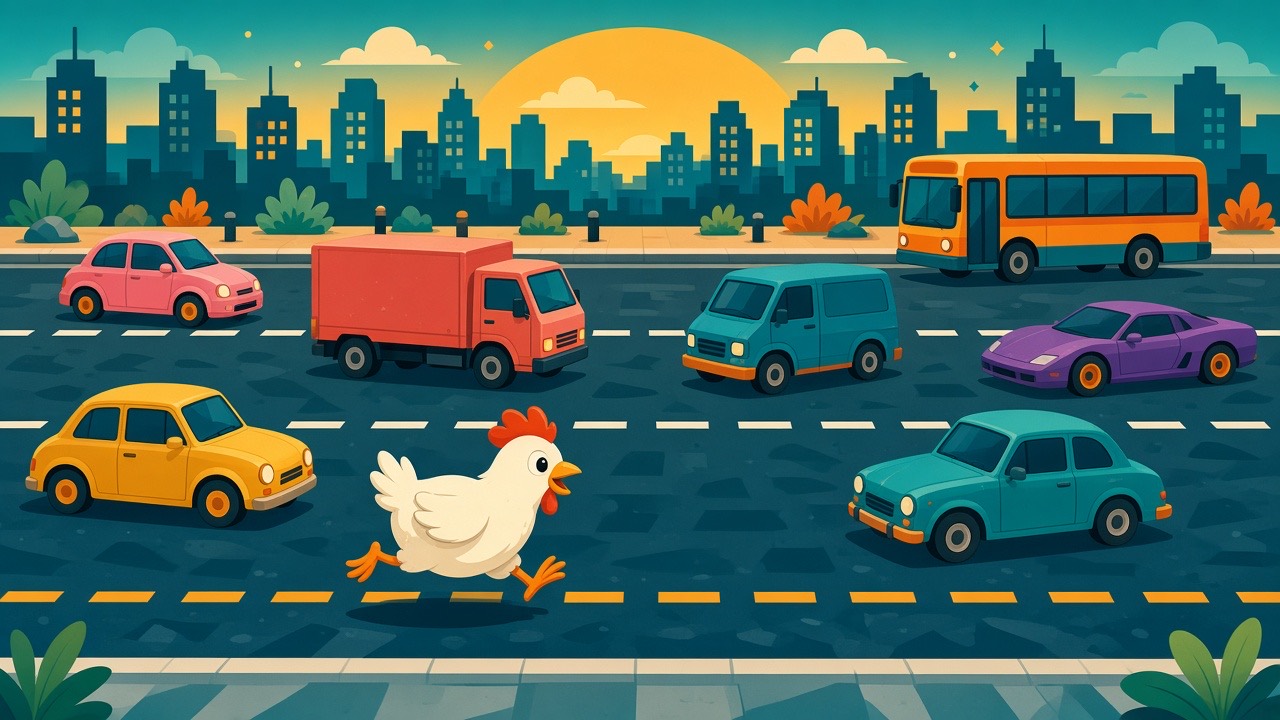
Chicken Road takes the punchline everyone has known since childhood and asks the obvious follow-up: fine — but can you actually do it? You tap, your chicken hops forward exactly one lane, and a wall of traffic decides whether that was a good idea. There is no combo system, no upgrade tree between you and the next attempt, and no way to blame anything but your own thumb.
What makes it stick is that the difficulty is entirely legible. Every vehicle is visible before it matters, every lane has a rhythm you can read, and every death is a decision you can name out loud. That is the rarest thing in casual gaming: a loss you immediately understand and immediately want to re-run.
The design lineage runs straight back to Frogger in 1981, but Chicken Road strips out the timer and the lily pads and keeps only the pure lane-reading tension. The result plays like a fidget toy that occasionally becomes a test of nerve.
A single input means the game can never be blamed for a mistimed swipe. You either read the gap correctly or you did not, and that honesty is the whole appeal.
Hatchbacks are fast and forgiving, delivery trucks are slow and enormous, and the bus lane is a genuine wall. Veterans stop watching vehicles and start watching the gaps between them.
Kernels always spawn in the lane you should not be standing in. Every one you take is a small bet against the next car, which turns a safe run into a greedy one.
Nothing speeds up unfairly. Instead the gaps quietly narrow, so the game gets harder without ever feeling like it changed the rules on you.
03 — The sequel
Same chicken. Same single tap. Now it is raining, the road is moving, and the city never turns its lights off.
 Sequel · Night city · Still no wagering
Most arcade follow-ups bolt on menus. Chicken Road 2 did something harder: it kept the one-tap contract completely intact and changed only what is underneath the chicken's feet. The road now slides. Platforms drift between lanes. Rain shortens how far ahead you can read, and fog occasionally hides an entire row until you are standing next to it.
The move to a neon night city is not just paint. Headlights become the primary warning system, so you learn to track light instead of shape, and wet asphalt reflects an oncoming vehicle a half-second before the vehicle itself is visible. Players who mastered the original spend their first ten runs unlearning daylight habits — and that friction is exactly what makes the sequel worth playing.
The single most argued-about addition is the rewind feather: one per run, it undoes your last hop. Purists call it a safety net. Everyone else uses it on lane 90 and never mentions it again.
Rain cuts your read distance and makes stopping distance matter. Fog hides a full lane. Clear nights are the only time a long run is genuinely safe — and the game knows it, so they are rare.
Drifting platforms and conveyor strips mean standing still is no longer neutral. Doing nothing can carry you into traffic, which quietly converts a patience game into a timing game.
One undo per run, and only for your most recent hop. It rescues a misread, never a reckless dash — the timer restarts the moment you land, so panic-tapping wastes it.
The daily route generates the identical traffic pattern for every player on Earth for 24 hours. It is the only place where comparing scores actually means something.
Neither game involves betting, deposits, cash prizes or any form of real-money play. Both are score-based arcade titles.
04 — The line-up
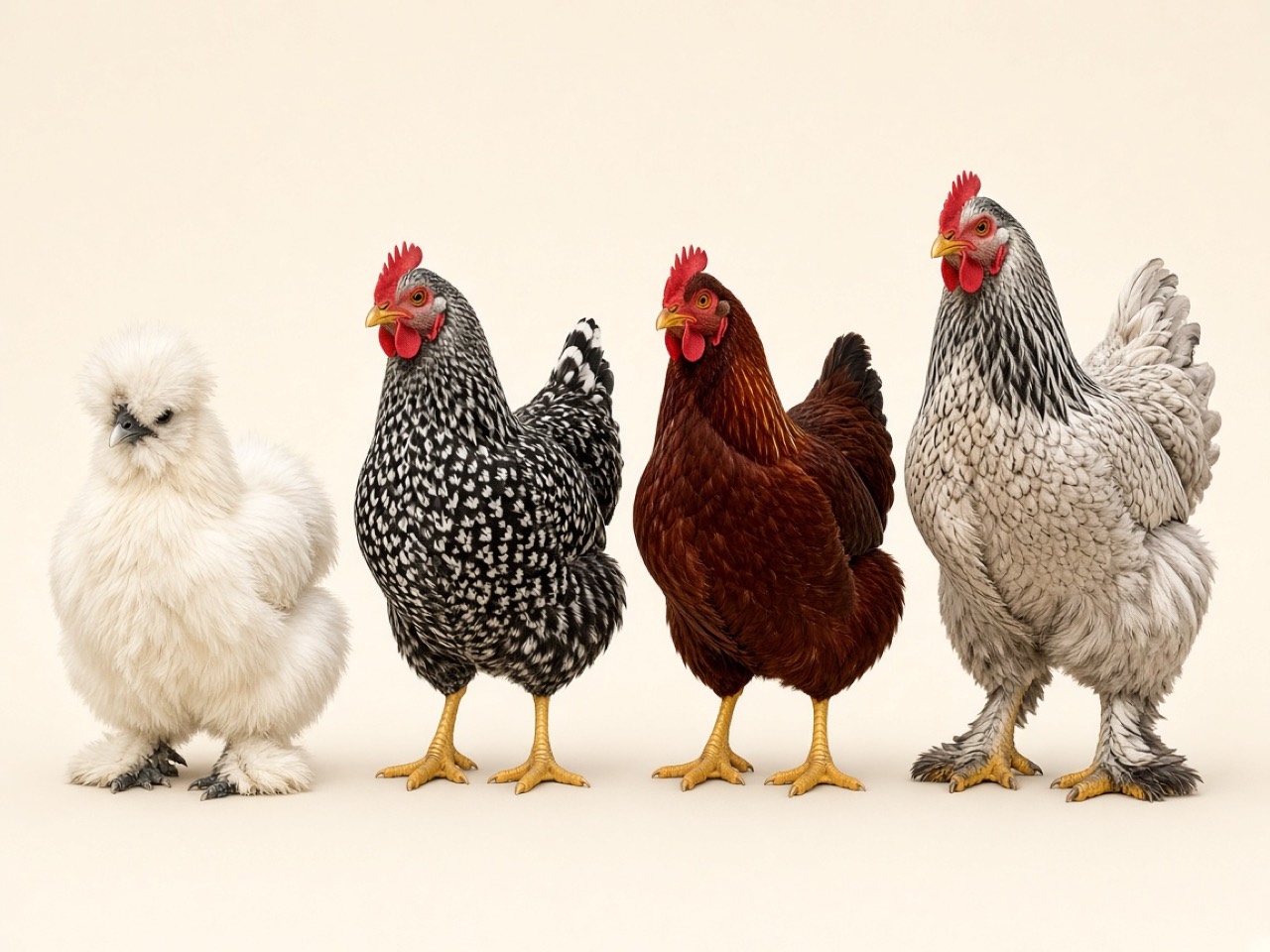
There are well over 500 recognised chicken breeds, and the gap between them is far wider than the gap between most dog breeds. Here are four that make the point.
The one with fur
Its feathers lack the barbs that zip a normal feather together, so it grows what looks like fluff. Silkies also have black skin, black bones, five toes instead of four, and the most reliable brooding instinct in poultry — keepers use them to hatch duck and pheasant eggs.
The dependable one
An American dual-purpose classic in barred grey and white. Calm, cold-hardy and famously unbothered, it keeps laying through winter when flashier breeds stop, which is why it anchored family flocks for a century.
The industrialist
Deep mahogany, relentlessly productive, and the genetic backbone of nearly every commercial brown-egg layer alive. Around 250–300 eggs a year from a bird that will happily forage for most of its own food.
The gentle giant
Roosters reach 30 inches tall and 5 kg, with feathered legs and feet. Despite the size they are placid to the point of being slow, and in the 1850s a Brahma craze swept Britain and America as a genuine speculative bubble.
05 — The mind
The phrase “bird brain” survives because chicken cognition was barely studied until the 1990s. When researchers finally looked properly, they found an animal that keeps track of social relationships, plans a few steps ahead, and adjusts its behaviour based on what it thinks another individual can see.
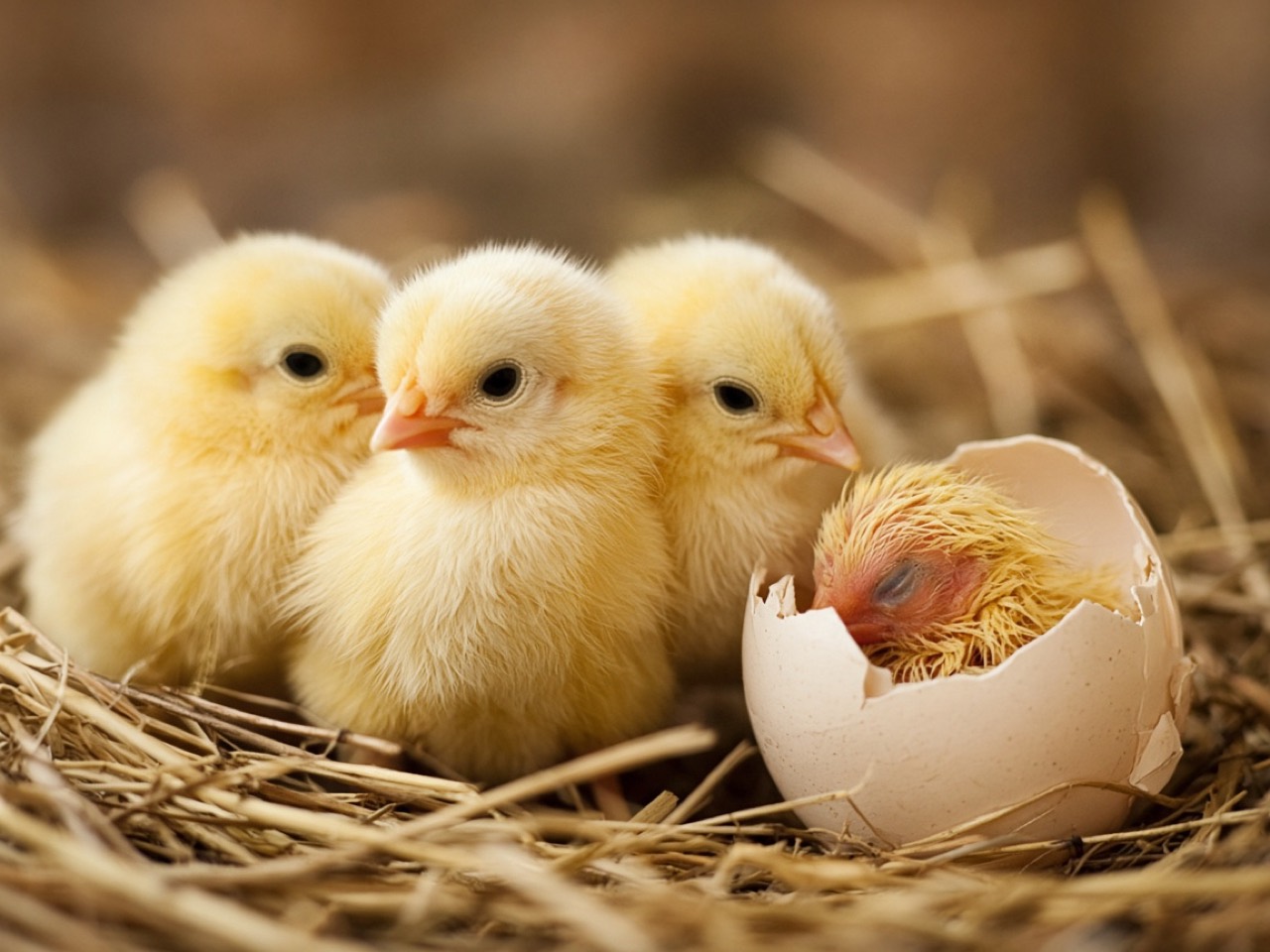
06 — Twenty-one days
Chicken embryology runs to an almost suspiciously precise timetable, which is exactly why the chicken egg became one of the most important model systems in developmental biology.
07 — Questions
They are dinosaurs, in the strict cladistic sense — birds are the surviving branch of theropods. Protein fragments recovered from a Tyrannosaurus rex femur matched chicken collagen more closely than that of any other living animal tested.
Roughly 26 billion at any given moment, making the chicken the most numerous bird on Earth by an enormous margin — about three chickens for every human being.
Yes. Hens learn and retain more than a hundred individual faces, human ones included, and behave measurably differently toward familiar and unfamiliar individuals.
No. Chicken Road as covered on this site is a casual skill-and-timing arcade game. There is no wagering, no deposit, no stake and no cash prize. The only things you accumulate are lanes crossed and corn collected, and neither has monetary value.
A neon night setting, moving platforms and conveyor lanes, rain and fog that change how far ahead you can read the road, a corn economy that unlocks cosmetic birds, a worldwide daily route, and one rewind feather per run that undoes a single hop.
A Plymouth Rock or a Rhode Island Red. Both are hardy, calm, forgiving of beginner mistakes and lay well through their first several years. Save the Silkies and Brahmas for once you know what you are doing.
No. This site is purely editorial. We publish free educational content about chickens and about the Chicken Road arcade games, and we do not sell products or operate a store.